Contrast
Contrast is the visual effect we see from the range of white to black as it corresponds to highlight and shadow.
Contrast is usually measured as the slope of the characteristic curve and in early literature this was usually described as the slope of the straight-line portion of the curve in the centre. Often this portion of the characteristic curve of a film is not completely straight, and so contrast is frequently measured today as an average slope over that part of the curve.
The methods of calculation are often different for different types of film in order to obtain a value, which most closely represents the effective contrast under normal conditions of use.
The slope of a straight-line section is known as the Greek letter "gamma".
The term gamma has now been truly fossilised in our terminology, it's original meaning [and it's present day mathematical meaning] of the slope of a straight line, has been largely forgotten and many film technicians talk of gamma when what they really mean is the contrast of some material with no true straight line and whose contrast is measured by some other method.
Many modern materials often do not have these straight line sections and colour materials almost never so that other parameters are used to calculated average slope.
These parameters are been given various names or symbols; alpha, the slope of a line drawn between two points on a curve is the most commonly used parameter for contrast and, since the toe of the curve is also important, other measures have been devised to take these regions into account.
Contrast Index is a measure devised by Eastman Kodak. It can be measured by laying a special meter over the curve. The numerical value is always slightly lower than gamma would be on a straight line. These averaging methods are sometimes called Best Fit Contrasts or beta.
The link between contrast and development time for any particular emulsion can be displayed on a "time-contrast" curve. The longer the development time the higher the contrast produced.
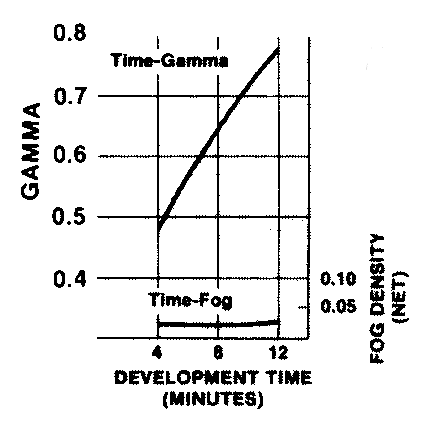
A Time/Gamma curve.
Colour materials also increase their contrasts with increasing development time but this is rarely relevant, as the three layers do not increase in contrast at the same rate. This means that there is only a narrow development range over which the three layers produce similar contrasts.
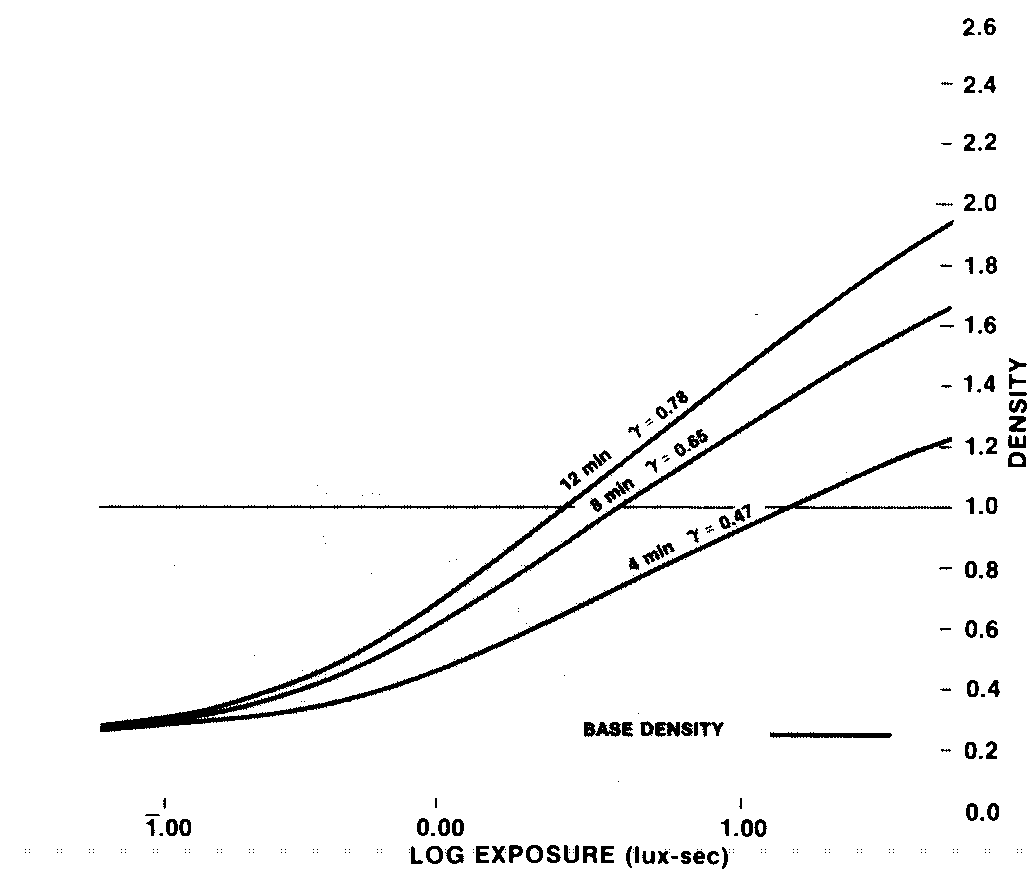
A Gamma curve of Negative B&W film. By increasing the developing time we increase the contrast (in this case: 12 min=0,78 / 8 min= 0,65 / 4 min = 0,47); note also that the three curves have different slopes.
Maximum density (called D-Max)
D-Max of a negative film is the density at which further increase in exposure fails to cause any further increase in density. For a reversal film, D-Max is the density of processed, unexposed film.
Minimum density (called D-Min)
D-Min of a negative film is the density of processed, unexposed film.
For a reversal film, D-Min is the density at which further increase in exposure fails to cause any further reduction in density. Also called Fog level this is the level of least density recorded on the film after processing - i.e. in an area that has received no exposure.
Normally, this also includes the density of emulsion support and this may well contribute the greater part to the so-called 'fog level'.
True fog level varies with different product types, the age of the emulsion and processing conditions and chemistry and is strictly the lowest density of the emulsion.
Sometimes the term 'stain' is used to describe the lowest density above that of the base.
The D.Min may indeed result from genuine chemical staining, especially on archive film, rather than silver or dye, but all these terms are widely confused. It is best to use the term D.Min only.