Density
If a sample of transparent or semi-transparent material such as processed film is illuminated by light of intensity I and the intensity of light transmitted by the material is T, then -
DENSITY = LOG 10_I_T
Density was originally expressed as a Logarithm to the base 10 simply because of the convenience of doing so, however the human eye responds to light intensity in a logarithmic way and, for example, a grey scale in which the density increments are in equal units, appears to the eye to have "equal" visual steps.
The human eye responds more or less logarithmically to changes in light intensity. In other words, equal changes in light intensity do not appear equal over a wide range of intensities, whereas equal changes in Log (Intensity) appear almost equal over the whole visible range.
For carrying out all photographic response calculations it is conventional to work in terms of Density and Log10 E. Quite apart from the visual equivalence Log values have other benefits. If linear units were used, any graphs plotted would have to be enormously large in order to have sufficient scale magnification at the low end of the scale.
A further benefit of using Logarithmic units of exposure and "light-stopping power" are that it provides a simple relationship between them.
For example, if the density of filtration in the light beam of a printer is increased by 0.1 density units this will reduce the Log E also by 0.1, assuming the exposure time is kept constant. Changes in Log E are also easy to relate to camera f-stops. Since log 10 2 = 0.3 a change in exposure of one camera f-stop is equivalent to a change of 0.3 Log E, a change of 2 f-stops gives a Log E change of 0.6 and so on.
If a strip of film is given a series of exposures and after processing the densities are measured a graph of the response of the film can be plotted.
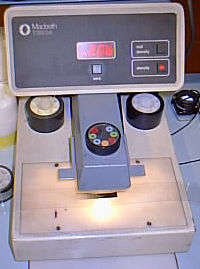
On the left you can see a Densitometer.
In this case, by rotating the knob on the reading head, you can select the
colour you want to measure. Readings will be then shown on the red display.
Modern densitometers can also be connected to computers, so that readings can
be automatically stored.