Practical densitometry
|
To restate: |
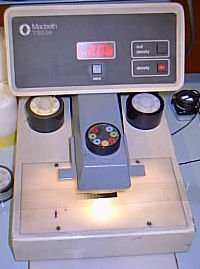
Densitometer
The instrument used for measuring density is a densitometer.
Densitometers have existed in many forms. The earliest are the null reading type where the light is split into two beams. One beam passes through the film and the other through an adjustable attenuator. The photocell is used to measure when the light from each beam is equal. Densitometers of the null type have been available where the eye is used instead of the photocell.
The commonest type of densitometer in use today is the photoelectric direct reading type. Light from a lamp is focused on the film being measured and a photosensitive cell measures the light passing through the film. Densitometers come in many forms. The majority of densitometers used today use voltmeters to measure the output of the cell directly and the most modern models have digital displays.
There are three different optical arrangements, sometimes called optical geometries, for density readings, and each produce a different density value from any film emulsion.
- Specular density where the light falls on the image normally and only the normal component of the transmitted light is measured.
- Diffuse density where the light falls on the image normally and all the transmitted light is measured.
- Double diffuse density where the light falling on the image is completely diffuse and all the transmitted light is collected.
In motion picture control standard diffuse density is used as it simulates practical use conditions of contact printing and small changes in the measuring geometry of the instrument have little effect on density readings. The available density range of a motion picture densitometer with the filters removed should be at least 0 - 7.0 so that with the complex colour filters in place it should have a density range of at least 0 - 4.0. This covers the highest densities likely to be found with film materials.
For picture materials the recommended photocell is the S-4 cell or it's equivalent. This has a response peak at approximately 550 nm to simulate the response of the human eye.
For soundtrack materials the recommended photocell is the S-1 cell. This has a response peak at approximately 800 nm, similar to the photocells normally used in projector sound track systems.
A tungsten lamp with a colour temperature of 3000 degrees K is normally recommended, as this is a very stable light source. Modern densitometers sometimes use tungsten halogen lamps with a higher colour temperature than 3000 degrees K but the spectral response of other parts of the system is then modified to give the required overall spectral characteristics for the instrument.
The filters are very critical in some aspects of densitometry but the specifications are usually given for specific light sources and photocells. The Kodak "Status" system is now universally used for modern materials and recommended for all process control.
 Control of Densitometers
In time densitometer results drift due to changes in spectral emission of light sources [both colour temperature and output tend to reduce with age], sensitivity of photocell, spectral transmission of colour filters [filters may fade, or be damaged in use] and changes in the alignment of optics.
Densitometers are usually checked using a very stable filter or plaque that does not easily change with time. Several devices are available for this purpose including for a full colormetric and photometric check, the Kodak Transmission Densitometer Check Plaque.
On the left: a densitometer
Status densitometry
The status filter or filter set is specific to a product or emulsion type and is dependant on the use of the material.
