Frictions and tension applied to the film
It is essential that a person who is winding a film be in complete control at all times. One should be able to stop the film at any given moment, without the film running on and falling on the floor - or even worse, getting tangled up in the winding mechanism.
Some form of restraint should be applied to the paying out plate, because, if it is allowed to freewheel, the damage mentioned above could occur. What is more, a smooth, flat and firm wind will not be obtained at the other end. One way is to apply the palm of the hand to the surface of the roll of film (not to the surface of a strand of film). Having suggested that one should apply some form of restraint whilst winding, there is also the school of thought that if a restraint is applied to one of the plates, i.e. preventing it from rotating, then the film itself will have to turn around. The objection here is that friction will build up between the two surfaces and a certain amount of wear to the edge of the film will take place, insignificant though this may be. At the same time that this is happening a build-up of static is also taking place.
Our answer to this objection is that at the speed we wind our films (i.e. never very fast) the chance of static building up is minimal and if there is a build-up it is quickly dissipated. Wear should not take place if the reel that is being wound is firm and flat in the first place.
The argument for and against using a restraint can be continued at great length, but the simple fact remains that each individual roll of film should be treated according to its merit and physical condition.
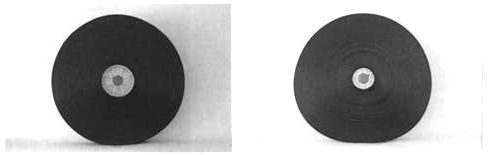
|
Compare the two reels: the one on the right has been rewound too loosely. |
Winding speed
In general, the speed at which one winds a film is governed by the physical condition of the film, but having said that, under no circumstances should any film be wound quickly, as this may create problems of static. The film should be wound at such a speed that an even, firm wind is achieved throughout and that at all times the film is strictly under control. The film should not be wound too tightly or too loosely, as this will damage the emulsion surface.