Viewing Tables.
Viewing tables can come in all sorts of arrangement and design. But basically they are useful to actually see the film in motion. Obviously, the quality of the image you can have on the small screens of viewing tables, and under the limits of lamps that are used, of the optical components usually rotating prisms, that produce all sorts of aberration to the image. The photographic (contrast, density, resolution, etc.) and mechanical qualities (steadiness, scratches, etc.) can be checked only to a limited extent. Nevertheless it can be considered as an alternative to projection, which is usually impossible or not advisable for the high risk of damage to the material.
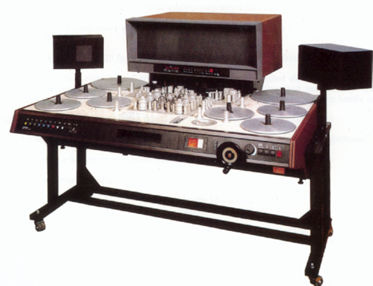
In some cases, viewing tables or editing tables equipped with two or three screens, are quite useful for comparing different elements, even though we must keep in mind that it is practically impossible that the two screens produces the same results in terms of quantity and quality of light and of steadiness.
According to their design, viewing table can be more or less suitable for fragile or shrunk materials.
Whenever is necessary to view fragile or shrunk films, special care is to be used in order to avoid damage; friction and tension to the film must be checked and carefully adjusted, while sometimes changing a "recommended" path can help the film to run through safely.
|
A 2-screen, 8 plates viewing table |
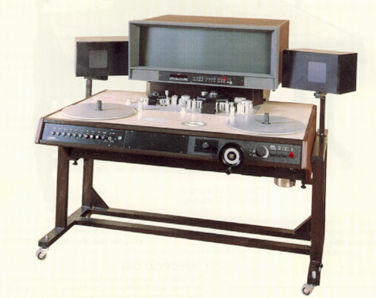
A 1-screen viewing table |