Handling the film
The equipment
Whenever we are confronted with the need to check a reel of film that has not been checked before, we must be sure not further damage the film. The reel can be in poor conditions, and therefore it might be unsafe to unwind it on a synchroniser or on a viewing table, where sprockets could produce damage to perforations, and excessive tension applied to the film might produce tears and opening of splices.
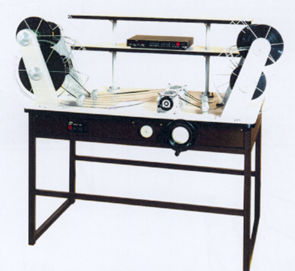
Therefore, it is advisable to proceed to the first inspection of the film material on a film winder (or inspection bench).
Only after having completed this first inspection, and having verified that the condition of the film are such to allow the use of other equipment prior to any other repair of treatment, and if we think it is important for whatever reason (checking of steadiness, identification, comparison with other materials of the same film, etc.), we can carefully use other equipment, such as synchronisers, viewing tables (MOVIOLA), or even projectors.
More on the equipment:
The core
As it happens with many equipments and materials used in the long history of film industry, a wide range of cores, differing in size, shape, and materials were in use in these hundred years. This means that whenever you open a can containing an old film, you might be confronted with any of these "strange" cores. According to their dimensions and characteristics, you have to find a way to unwind the film, paying a constant attention to avoid any damage to the film.
Today, form and dimensions of cores are standardized, they are all in plastic (it is important to keep in mind that old plastic cores might be made of certain old type of plastic which could be harmful to the film, so it is always advisable to replace them). Most commonly you can find them in two diameters: 75 mm (3 inch) or 50 mm (2 inch). For archival use cores with a larger diameter are to be preferred. For special applications (as in the case of some magnetic sound elements) you can also find cores with a diameter larger than 75mm (3inch).
Most frequently, when you open the can of an old film (but it also happens with brand new prints returning from projection!), what you find is a reel without core. What to do then? In order to safely unwind the film, it is advisable to have a core at the centre of the reel. First, you can try to insert a core, if the hole at the centre of the reel has a convenient diameter. If not (often it happens that reels of old films have quite small holes), you must not, for any reason, try to force a new core into the hole: this will surely damage the film! Rather, you must anyway ensure that the film is not in direct contact with the pivot of the table's plates, which might damage the film by scratching or tearing it; therefore you must make up a small roll of scrap film, of suitable diameter and insert it in the reel's central hole. This small roll will protect your film and will act as a core.
Winding
Winding a film is considered too often as something relatively easy. Very
often we are winding a reel without really paying attention, because it has
become an automatic and daily activity. On the contrary, we must be always
concerned by the fact that we can produce all sort of damage to the film while
we are doing this "supposed to be" easy operation.
A particular care must be paid when we wind an original element, or in wider
terms, a preservation master. We will later see what sort of damage can be
produced by wrong handling or by unsuitable equipment. In general terms the risk is to produce
mechanical damage, as scratches on both emulsion and base, weakening or opening
existing splices, breaking perforations, making the film even dirtier than it
is. Also producing finger marks, winding the reel irregularly, so that damages
will happen on a later stage (e.g. when the reel is lifted or it is put back in
the can), and to produce severe damage to emulsion when trying to unwind a film
which has become sticky because of decomposition, or highly fragile, or
brittle.
Procedures in winding
 Winding Friction
& Speed
Winding Friction
& Speed
Measuring Film
It is commonly desired to measure the length of a film and this is usually done with an instrument consisting of a sprocket with a roller to guide the film to it and one to guide the film away from it.
The sprocket is connected to a counter mechanism that indicates the length of film, which has passed the sprocket, in feet or in metres.
It is important that:
- The instrument is mounted in correct line with the film turntables, so that the film is not pushed sideways or twisted as it approaches and leaves the instrument.
- When used with shrunken film it is necessary that the film does not pass too far round the sprocket, engaging too many sprocket teeth. It may be necessary to modify the instrument in order to achieve this.
- In particular, films on a nitrate base that have been severely shrunk require specially designed sprockets so as to not damage the perforations.
- Since the instrument must impose some load on the perforations of the film, the whole mechanism should turn as freely as possible.
- No bearings should be tight and all should be kept lightly oiled to minimize the tug on the film. New technology does permit measuring devices without mechanical parts that do not contact the film and impose no strain, but these are not generally available.
|
On this vertical synchroniser, a
digital counter is mounted: you can see it on the shelf. |
Film Wrapping
The greatest danger to nitrate film is its gradual decomposition to the point of self-destruction; and since it is important for the vapours of decomposition to escape because they accelerate the decomposition, the wrapping of nitrate film is not advocated because any wrapper will limit the escape of the vapours.
In the case of acetate safety film there appear to be two good reasons to wrap the films:
- A wrapper will tend to limit the escape of moisture and solvent. A loss of these components leads to shrinkage and brittleness.
- A suitable wrapper will help
to prevent dust and pollutants from reaching the film from outside.
Most paper is not very suitable as it is acid. There are acid-free papers made especially for wrapping photographic materials, but these are expensive and not readily available.
Polyethylene bags are suitable and cheap.
Also one may be able to obtain from film processing laboratories the bags in which film stock manufacturers wrap the raw film stock. These are suitable, being selected for the very purpose of wrapping film.
Marking The Films
The correct identification and marking of the reels is of importance, but the exact information that is written onto a leader will depend on the requirements of the individual archives or laboratories. These are some of the information that you might find on leaders: title of film, reel number / number of reels, head or tail, which film element (as negative, positive, dupes, etc.), location number, nitrate/safety (and sometimes polyester/acetate), if it is a "master print" or a viewing print etc. As we said, which information, and the form by which they are written on the film can differ. It is anyway important that the form of writing these information is consistent within the laboratory or archive to help understanding the information at first glance. Usually, it is advisable to write at least film title and number of reel.
Marking information on the leaders of the film (and, obviously, NEVER on the film itself!) helps in identifying it with no doubt; to mark "head" or "tail / end" will also save precious time and will avoid too many unnecessary manipulations of the film, which can damage the film or just make it dusty and dirty.
Damage Due To Unsuitable Equipment
The use of unsuitable, faulty, or incorrectly installed equipment can lead to damage to the films. Some common cases are:
Misaligned winders
If a pair of winders is mounted so that the film does not pass straight
from one to the other, it may be pushed with its edge rubbing on the edge of a
spool or turn-table, which can cause scratches, or cause a broken perforation
to catch on the spool and thus aggravate that damage.
Sprockets
If the sprocket teeth are allowed to become worn and hooked and the
sprocket continues to be used, the teeth can catch and tear perforations
instead of sliding smoothly into and out of them.
In addition, if film is shrunk and if the film is wrapped a long way around a
sprocket. The sprocket teeth at the ends of the wrap-around inevitably foul the
perforation and cause strain, distortion, or tear. This applies to sprockets on
any piece of apparatus.
Bent spools
Always use spools and winding plates that run true. If bent, they can
easily touch the film surface and cause abrasion, or they can catch in any
broken perforation and aggravate the existing damage.
Misaligned footage counter
The film needs to pass in a straight path from feed side to take-up side with
no sideways push, such as a misaligned counter would cause. The resultant
damage could be torn perforations due to the perforations not properly meeting
sprocket teeth. The film could be moved sideways so that the film rolls off the
sprocket and the teeth could dig into the picture area.