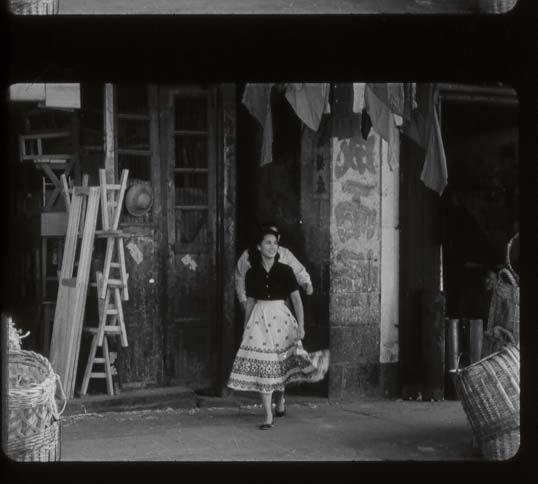



gamma = 1.5 Print from camera neg
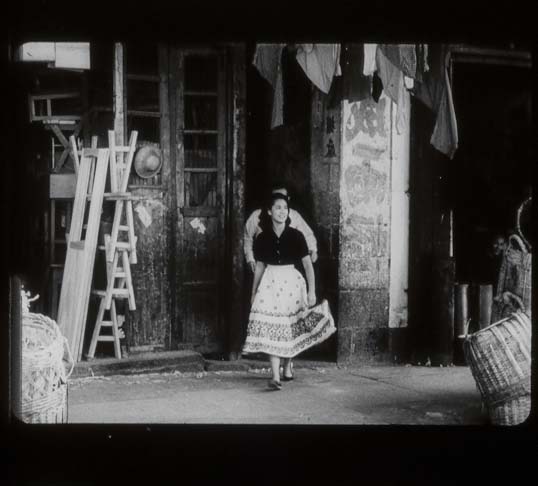
gamma = 3.8 Print from neg made from print
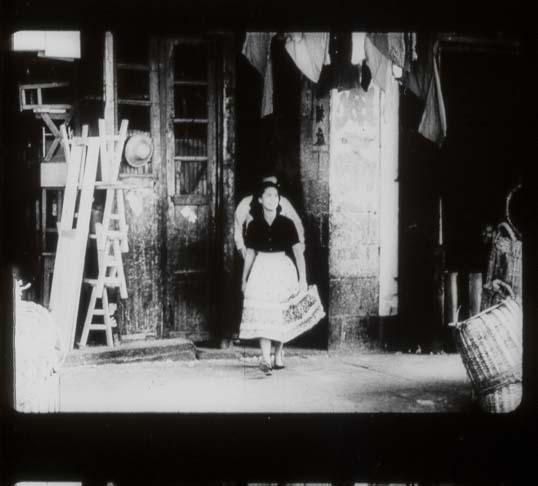
gamma= 5.8 Print made from print from neg from print
Quality in Motion Picture Duplication
Brian Pritchard
Introduction
Motion picture films are duplicated to prevent the camera master being damaged by making a large number of prints, because printing facilities are needed in more than one place, to protect the original or to protect a film that might decompose because of the type of film base used.
Whenever a film is duplicated it is usually the intention to preserve the qualities of the original. Usually, because sometimes the original can be improved during duplication, for example if the negative has excessive contrast it can be reduced during printing.
We are attempting to retain the tonal range and to retain maximum sharpness. We can retain the tonal range by careful work at each duplicating stage. Colour is more difficult than black and white because we have very little control of the colour processes and we are coping 3 layers simultaneously. Trying to alter processing times can lead to the introduction of uncorrectable colour distortions. Retaining sharpness is even more difficult because every factor in the printing process will affect the result. Flare is another factor that has to be considered but is often forgotten.
Sharpness and Definition
There are a number of ways to quantify sharpness and definition in film stocks. The resolution, acutance and modulation transfer function (MTF) can all be measured.
Resolution is measured in lines per millimetre, actually line pairs per millimetre. A line pair is a white and a black line. The difference between the white and black gives the contrast of the lines. The resolution is determined by the frequency at which you can just distinguish the difference between the black and white lines. Because the judgment is visual it is also subjective and depends on the observer’s eyes and skill.
Resolution varies with several factors independent of the emulsion. Contrast and exposure will alter the resolution [1] Stock manufacturers quote the resolution for two different contrasts. Kodak quotes for contrasts of 1.6:1 and 1000:1. Better resolution is achieved with higher contrast images. For example the resolution of 5302 Kodak Fine Grain Release Positive is 63 lines/mm at 1.6:1 and 125 lines/mm for 1000:1. Under exposure or over exposure will decrease the resolution. Certain fine grain developers will also increase the resolution. There is also a relationship between fine grain and resolution. In general fine grain means high resolution but this is not true in all cases. For many years the measure of a film’s sharpness was the resolution of the emulsion. The apparent ease with which resolution can be measured made it appear a good method but the observer’s deficiencies limit the accuracy. It was also thought that the criterion of the reproduction of detail was a measurement of picture quality. However the sharpness with which detail is reproduced is more important than resolution off the detail. [2] The sharpness of a film is its acutance.
Acutance is measured by exposing a knife-edge onto the film and reading the density across the white/black edge with a scanning densitometer. The acutance is the average gradient squared divided by the density difference across the edge of the exposure. [3] Factors affecting acutance apart from the emulsion characteristics are the opacity of the emulsion, where scatter of light sideways within the emulsion changes the acutance and development phenomena such as adjacency effects [4] where exhaustion of the developer in heavily exposed areas cause reduction in density in the lightly exposed adjacent area thus increasing the acutance. Such effects are reduced in motion picture processing machines where there is extremely good agitation which removes exhausted developer diminishing the effect. The direction of processing can also affect adjacency effects; one direction of processing will mean that the exhausted developer will move from a light area to an adjacent black area avoiding the adjacency effect. If the film is run the other way then the developer will move from black area to light area giving the adjacency effect.
MTF has the advantage that lenses and other components in the printing chain have an MTF so the change in definition can be followed through the chain. The disadvantage is that a microdensitometer and an MTF target are required to make the measurements.
An MTF image consists of a series of patches of sinusoidal density of increasing frequency. The maximum and minimum densities of each of the patches are as near identical as possible although as long as the densities can be measured and are known it is not essential provided the densities remain on the straight line portion of the sensitometric curve. The difference between the maximum and minimum density is the modulation and is equal to 100%.
If this target is printed by contact (so we do not have to consider a lens at this stage) after processing we can then measure the maximum and minimum density of each patch using a scanning microdensitometer. If at a particular frequency our original patch had a density difference of 1.0 and now has a density difference of 0.8 then our MTF at that frequency is 80%. This measurement is repeated for each frequency and a graph plotted of MTF against frequency. If we wish to check the MTF of a lens then we repeat the test putting a lens between the test target and the film. The difference between the MTF with and without the lens is the MTF of the lens. An advantage of MTF measurements is that the final result of a chain can be calculated from the individual MTF measurements. A lens with an MTF of 90% at a given frequency photographing on to a film with an MTF of 80% will give an MTF of 72% (80% of 90%). The result of this means that every time we copy a film by whatever method there will be a loss of definition although some films, due to effects such as edge effects of the developer, actually increase the MTF at low frequencies.
It is essential to ensure that all equipment used in the duplicating process is well maintained and of the highest quality. Such things as the gate pressure in contact printers will have a result on the MTF. Lack of contact will lead to loss of MTF and consequently loss of definition. Wet printers will give less definition than dry printers. Of course an inferior lens will give poorer quality.
Without the effects of flare, lenses, contact and so on, just considering the film stocks a frequency of 60c/mm would be indistinguishable after making a Fine Grain Positive, Fine Grain Negative and a Print. When the modulation reaches less than 10% it is not usually possible to see the pattern.
Resolution can be approximately equated to the frequency at which the MTF is 50%.
Duplication Quality
The correct exposure for a camera film is calculated so that the highlights of the scene are placed on the toe of the sensitometric curve. It is placed there so that the film will accommodate the maximum brightness range of the scene. The distortion that is made to the tonal range by placing that part of the exposure on the toe is corrected to a great extent by placing the subsequent print exposure on the shoulder of the print stock. This will occur provided the processing of the two stocks is correct so that the curve shape is not distorted. If either exposure is incorrect or there is a distorted curve shape the final print will not reproduce the tonal range of the original scene.
The exposure of intermediates is different. Intermediates, that is duplicate positives, duplicate negatives, internegatives and interpositives, are exposed so that the exposure is placed on the straight-line portion of the sensitometric curve. This is because the distortion from the toe of the curve will be corrected when a print is made. For this reason duplicates are always heavier than their camera or print counterparts.
There are various methods for ensuring that duplicating routes are sensitometrically correct. Plotting a step wedge that follows the route will give the maximum information about the print through characteristics, however most laboratories use the Laboratory Aim Density system (LAD). The manufacturer publishes a density for each film that has to be achieved on each stock for the print through characteristics to be correct. A LAD patch of the correct density is cut on to the front of the film. When a duplicate or print is made the LAD is given a standard printer light. After processing the patch can be measured and it can be determined from the measurement if the patch has the correct density and colour.
It has to be mentioned that grading has just as much effect on the final result as does the correct line-up of printers and processors. In fact, probably more effect. A scene that is graded too light will give a picture on the screen that has loss of detail in the highlights with loss of detail in the shadows from a heavy print.
The most common fault in duplicating is increase in contrast. There are several definitions of contrast used in motion picture sensitometry, Best Fit Contrast, Average Gradient and Toe Gradient and Upper Scale Gradient [5] . These are definitions that are tailored to the particular use of the film. In talking about duplicating it is sufficient to consider gamma (g). Gamma is usually taken as the slope of the straight-line portion of the curve. The gamma of a camera neg is around 0.65 that of print stock is 2.40. Final gamma is the product of the gammas of the component films.
gamma Negative x gamma Positive = gamma Reproduction
The resultant gamma is
gamma = 0.65 x 2.40 = 1.56.
Theoretically the gamma to reproduce the brightness range of the original scene is 1.0 but because the camera lens adds flare, the projector lens adds flare; the printing machine adds flare and the projection room is not totally dark, it is necessary to increase the overall gamma. About 1.5 is the recommended aim to give the best approximation of the brightness range of the scene photographed.
When a duplicate negative is made from an original negative we have to go through an intermediate positive, known as a fine grain duplicate positive in black and white and an interpositive in colour. The resultant duplicate negative needs to have the same contrast as the original negative so the two stages must have an overall contrast of 1.0. The duplicate positive has a gamma of 1.35 and the duplicate negative 0.76.
gamma Duplicate positive x gamma Duplicate negative = gamma Reproduction
gamma = 0.76 x 1.35 = 1.0
All these calculations are based on ideal situations, in the world of archiving we very rarely are dealing with ideal situations, rather than a duplicating positive we might have a normal release print as our only facility. This would have a gamma of 2.4 if we make a normal duplicate negative, gamma 0.76, we will have a negative with a picture gamma of:
gamma = 2.4 X 0.65 = 1.56
If we now make a print on normal stock we end up with a print with a picture gamma of:
gamma = 1.56 X 2.4 = 3.8
If we did the same thing again the final result would be a gamma of 5.8. The result is loss of detail in the shadows and highlights.
Negative to Positive
Negative to Positive
Negative to Positive to Negative to Positive
Negative to Positive to Negative to Positive
Negative to Positive to Negative to Positive to Negative to Positive
Negative to Positive to Negative to Positive to Negative to Positive
Click on Pictures to see larger image.
g = 5.8 Print made from neg from print from neg from print
The pictures and the details from those pictures shown above illustrate this result, the loss of detail in the girl’s dress and in the shadow areas.
When we are faced with having to make a new print from another print we have to make alterations in our duplicating route. We have to reduce the overall contrast; this means making a negative with lower contrast or a print with lower contrast or even both.
We can lower the negative contrast a number of ways, we can use a different film stock. Instead of using duplicate negative we can use panchromatic separation stock. This stock can be processed in either the negative process or the positive process and gives a wide range of gammas. We can also change the development time for the normal duplicate negative stock. Shortening the development time will give a lower gamma. Flashing is a technique sometimes used where the raw stock is given a low overall exposure before printing. The danger of this technique is the possibility of scratching the raw stock during flashing or incorrect flashing exposure both of which would mean the job would have to be done again.
The print can be treated identically but we can also process the print through the negative process, which being a less active developer will produce a lower contrast. As was mentioned earlier, colour is more difficult because we cannot alter the process to any significant degree without introducing colour distortions such as cross curves, when one colour has a different contrast to the other two. This can be caused by altering the development time of the process so, if the magenta curve had higher contrast to the cyan and yellow in a print, we would see magenta highlights and green shadows which cannot be corrected.
Flare
Flare is defined as unwanted image-forming light. The optical components in a lens add flare to an image, halation within the film base is a source of flare, and lack of contact during printing will add flare to an image. Flare light has greatest effect on the low densities, the shadows in a negative and the highlights in a positive. This will cause distortion of the tones in those areas and alter the tone reproduction of the scene. The addition of flare exposure will also change the resolution, acutance and MTF of the film because these measurements depend on density differences. Flare is probably one of the most underrated factors contributing to image degradation.
Conclusions
To make the best possible duplicates it is vital to make sure that all equipment is in good working order, that all duplicating route are correctly set up and exposures are correct (grading is correct). Factors such as flare are must be controlled. All bright and shiny parts in the light path must be painted matt black to avoid flare-causing reflections. All optical components should be kept clean.
Careful choice of printing machine must be made, continuous contact printers will give poorer definition than an optical printer, and wet printers are less sharp than dry printers. Of course sometimes the choice is dictated and a small amount of loss of sharpness is sacrificed by using a wet printer in order to eliminate scratches.
If any duplicate stage is not the best achievable then it is not possible to completely correct at a later stage, contrast can be altered but if definition has been lost or tones have been lost they cannot be brought back, they are gone for ever.
Appendix 1 - Definitions of Contrast Measurements
The definition varies according to the film stock, for example the AG for 5271 was the Slope of Line joining speed point to a point 1.5 Log E above.
These are all for obsolete stocks.
Average Gradient: Slope of Line joining speed point to a point 1.35 Log E above. (Eastman Colour Negative 5254)
Toe Gradient: Slope of Line joining speed point to a point 0.4 Log E below.
(Eastman Colour Print 5385)
Upper Scale Gradient: Slope of Line joining speed point to a point 0.5 Log E above. (Eastman Colour Print 5385)
Best Fit Contrast: BFC= 0.7143(D6- D1) + 0.4762(D5 – D2) + 0.2381(D4 – D3)
Where D1 etc is the density at increments of 0.15 log E above a density of 0.4 above D Min (Minimum Density) (Eastman Colour Intermediate 5253)
[1] James & Higgins, Fundamentals of Photographic Theory, Morgan & Morgan, pp 295/6, (1959)
[2] Higgins & Wolfe, J. Soc. Optical Soc, Am, 45, 121 (1955)
[3] James & Higgins, Fundamentals of Photographic Theory, Morgan & Morgan, pp 287/8 (1959)
[4] Also known as edge effect
[5] See Appendix 1 for definitions