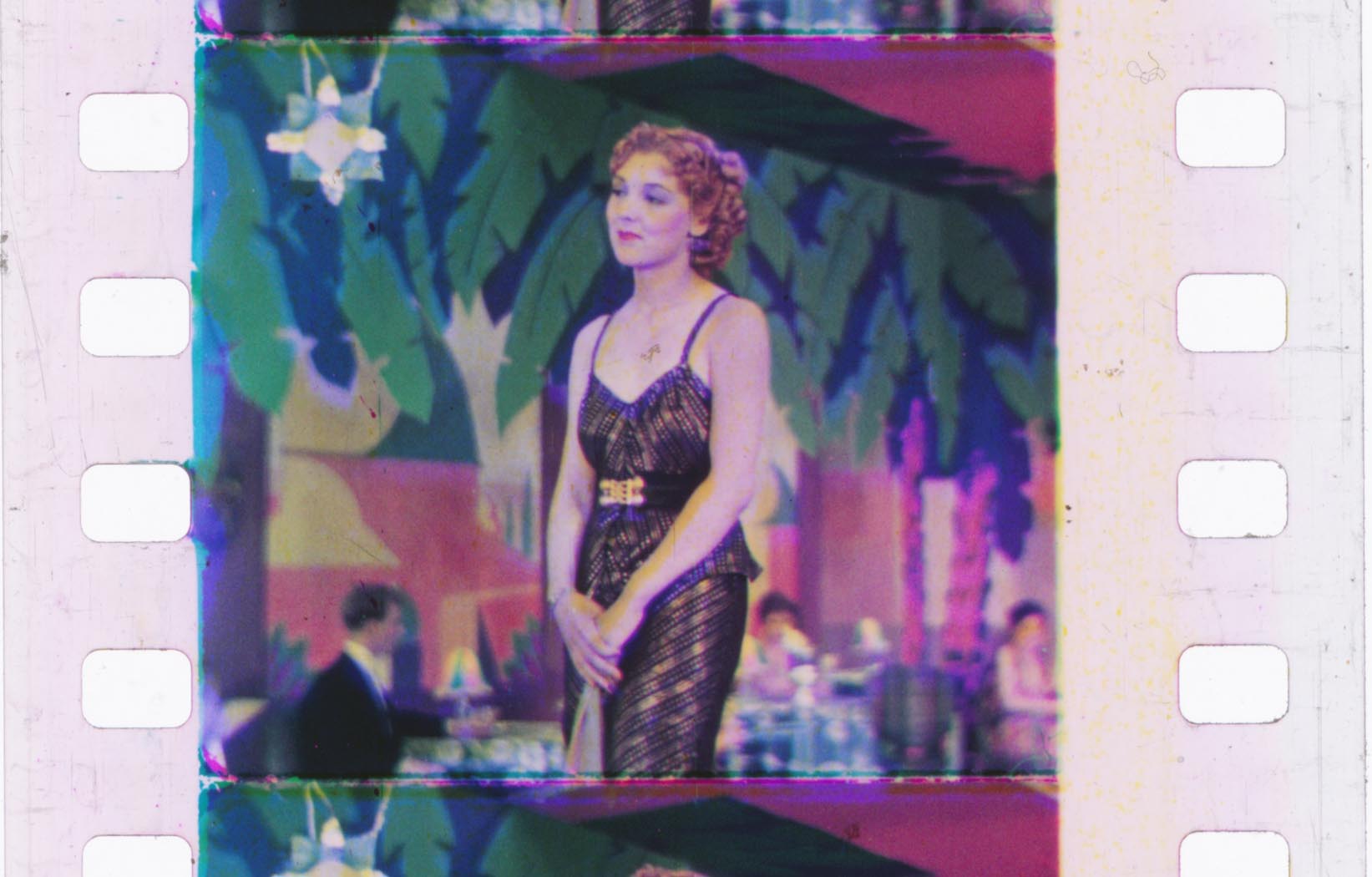
Brewster Colour was invented in 1913 by Percy Douglas Brewster
Brewster colour was a two-color subtractive color process introduced in 1915. For the original photography a red and a green separation negative was exposedi in a beam splitter camera. Prints were made on duplized positive film. The process was extensively modified after 1930 and made into a three-color system.
Roderick T Ryan ' Hisrory of Motion Picture Color Technology The Focal Press 1977 p 72-7
Obituary in the SMPTE Journal
Percy D. Brewster died on October 27 at his home at East Orange, N.J., after a longillness. He had retired 12 years ago. His work as a motion picture engineer led him tocredit as the inventor of several color photographic processes, with 360 patents grantedto him. He was President of the Brewster Color Film Corp. of Newark, N.J., and of theformer Revelation Film Corp. of London.He became a member of the Society of Motion Picture Engineers in 1929 and was madea Fellow in 1934. He was cited by the Royal Society of London for his work in colorphotography and was the first to make a color photograph of President Wilson. He wasgraduated from Cornell University in 1906.
SMPTE Journal Volume 59 December 1952 page 546
Brewster had a large number of patents in his name.
Cornwell-Clyne in Colour Cinematography 3rd Edition 1951 page 11 said: 'The bipack method of obtaining two-colour negatives is traceable again to Ducos du Hauron (FP 250,862, 1895) and A Guertner (BP 7924,1903). One of the first to apply the bipack system to cinematography seems to have been P. D. Brewster (BP 2465, 1915) and (USP 1,222925, 1917). He was also the first to use registering pins in cameras and projectors (USP 1,359,024, 1920).
There is a considerable amount of information on Brewster’s patents, his printing methods and his cameras in: History of Color Photography Josesph Friedman 1945 The American Publishing Company, Boston USA.
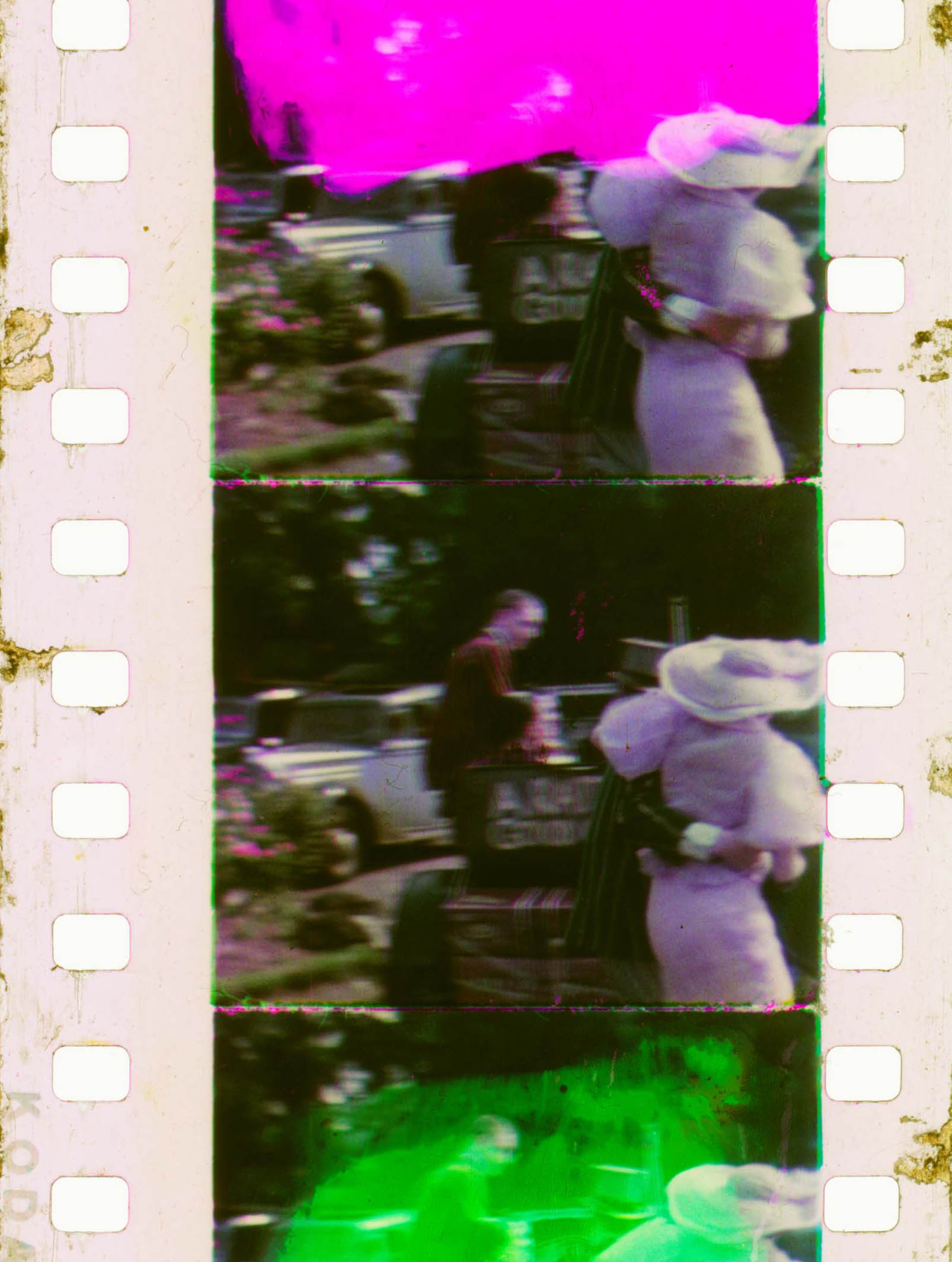
Click on the images to see larger images
Note the magenta dye at the top of the image and the mixture of cyan and yellow dye at the bottom. In the image at the top of the page you can see that the yellow image that was printed by imbibition is slightly out of position
A demonstration of three colour Brewster colour was presented April 12, 1935 to a joint meeting of the colour and kinematograph groups of the Royal Photographic Society. Among of the films presented was ‘Let’s look at London “ a film which showed interior and exterior scenes including a ballet performance. Comments regarding the showing were ‘remarkable steadiness‘, ‘extraordinary good reds’. It was believed the lack of sharpness was due to imbibition printing.
Roderick T Ryan ' Hisrory of Motion Picture Color Technology The Focal Press 1977 p 72-75
The Photographic Journal of the Royal Photographic Society August 1935 pages 455 and 456 has the full report of the demostration. There some extracts below.
Here is a section from:
Colour Cinematography 3rd Edition. Adrian Cornwell-Clyne, Chapman and Hall Ltd London 1951 P 411
Printing-Brewster employed double coated positive film printed on one side with a red filter negative and on the other side with a green filter negative. The development of these was carried to a low gamma and exposure was light. These two images were converted into silver iodide with basic dyes - a process originally invented by A Traube DRP 187289 1905. The side printed with a red filter negative was dye toned subtractive primary cyan; the side printed with a green filter negative was dye toned subtractive primary magenta. The remaining yellow component was printed on top of the dye toned image by imbibition from a relief matrix film made in the customary manner by developing with a tanning developer such as Pyro or Pyro and adurol. The unhardened gelatine was dissolved away with hot water after development. Such a method was elaborate and must have been somewhat difficult to control both as to registration and colour balance.
The following description appeared in 1935.
The red and green negative record records are printed onto two sides of a double-coated positive film. The images are bleached out to invisible silver iodide images and are toned with basic dyes to pink and blue. The pink side is then coated with another emulsion, which is exposed to the blue negative record and correspondingly tinted by new process which is not being divulged until further patents have been granted. Basic dyes are said to give an advantage over the acidic acid dyes used by Technicolor.
Sic: Adurol: a chlorinated (or brominated) derivative of hydroquinone used as a photographic developer.
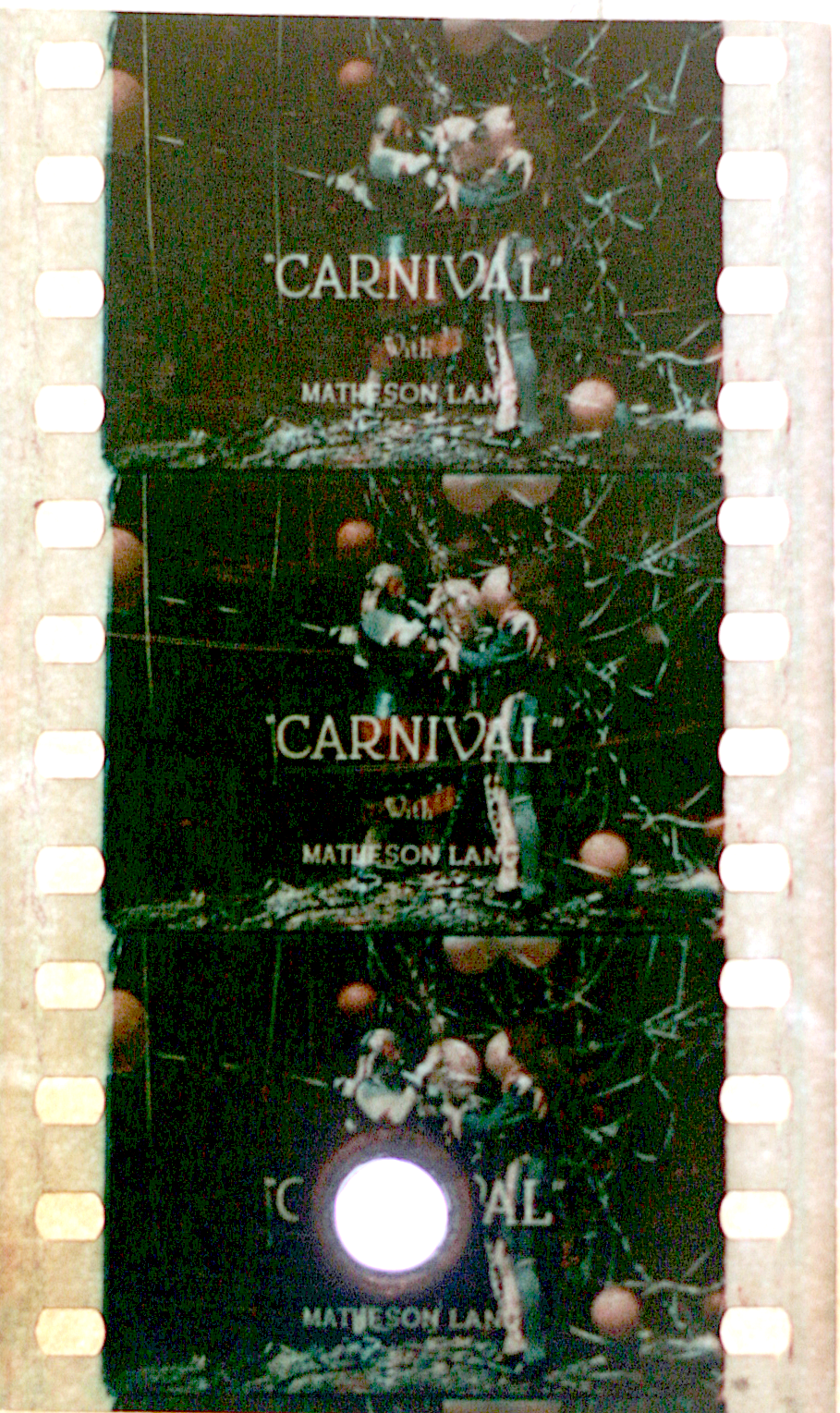
This image comes from the National Science and Media Museum, the Charles Urban Collection. The film is stapled to a piece of paper carrying written information. The sample could not be removed hence the poor quality. The sample is a title frame which says 'Carnival with Matheson Lang'
Carnival (1921) starred Matheson Lang, Ivor Novello and Hilde Bayley (INDB)
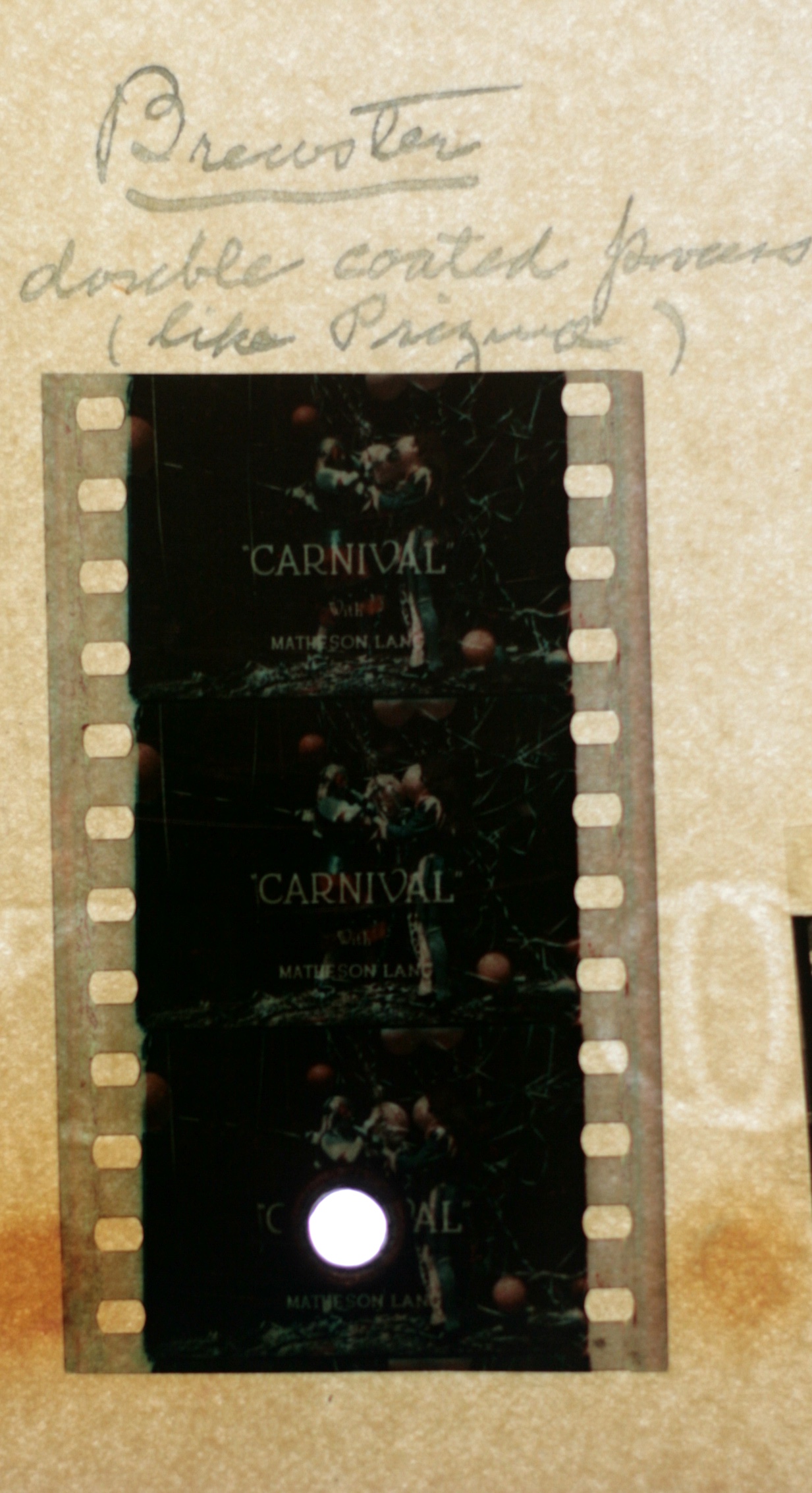
This is a photo of Urban's sample and note saying 'Brewster'.
Click on the images to see larger image.
Some extracts from the Photographic Journal.
The Camera
The real interest, however, was in the camera, which was patented about 1932. The patent described a beam-splitter inwhich the light from a single lens was divided up inside the camera so that it recorded on three separate films……
… That camera (said Dr. Spencer) was giving quite good service, but the use of the bipacks had several disadvantages, the chief being that the rear image, which was normally the blue printer., was always very slightly woolly, because in front of it was a silver emulsion which was scattering light. … Brewster's suggestion was that the light should be divided up between three separate negatives, each of which should receive light from the whole of the lens. The way in which that was done was to makeuse of metallic mirrors, rather like propellers, disposed at right angles to each other.
The Sound Track.
Some questions were asked with regard to the sound track and it was explained that a fourth printer was not used and so the track had to be either printed in one of the colours or else be a separate silver image. If they had printed it in all colours so as to get black there would be a risk of the sound going off when the colours ran out of register, so they chose one colour which in most of the shots shown was the magenta
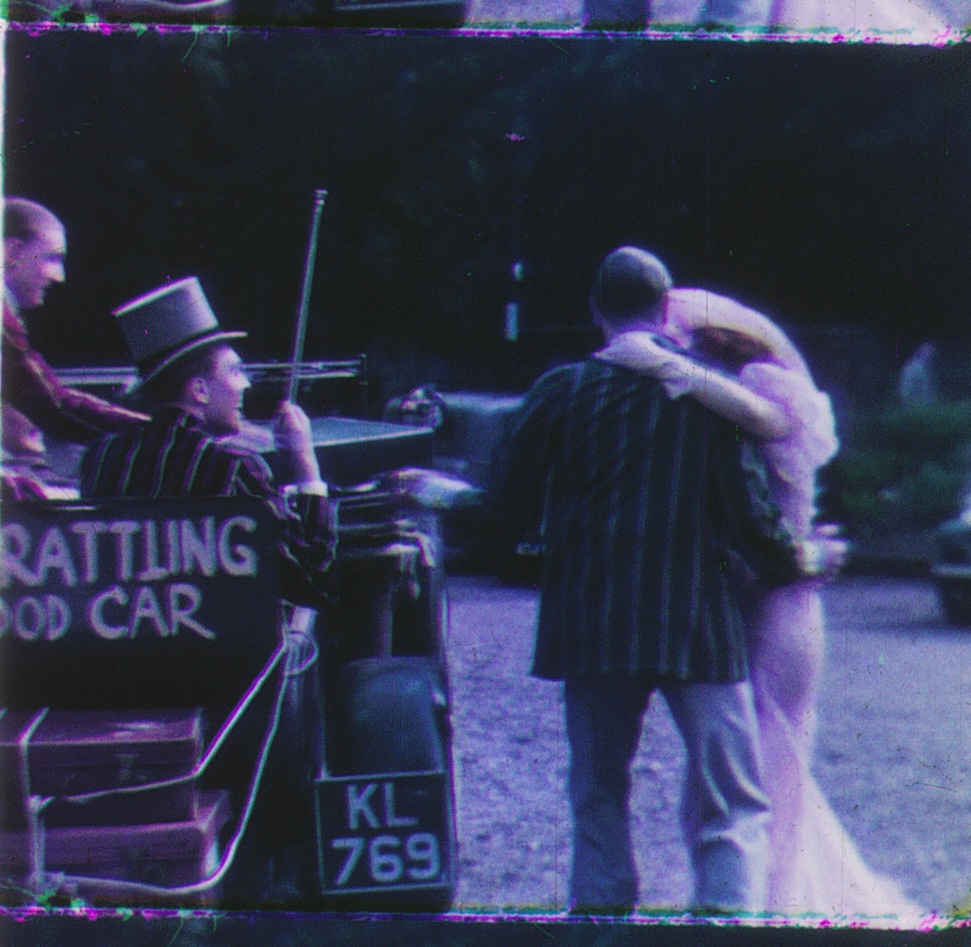
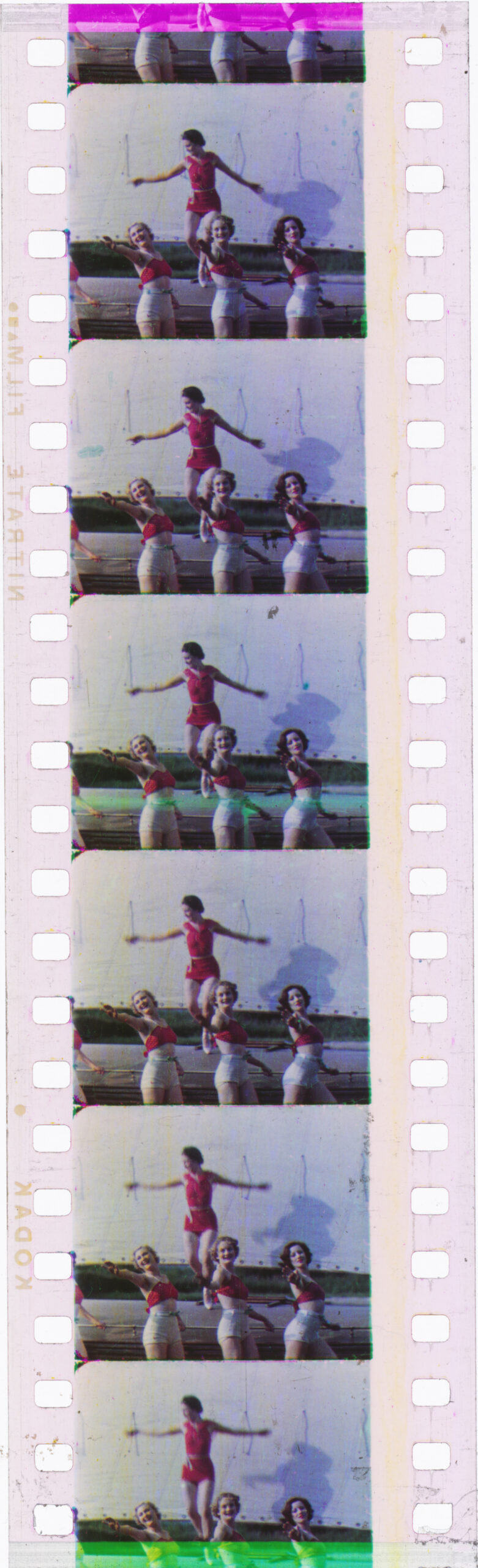
Another frame of Brewster Color. The edge printing says:
EASTMAN KODAK (circle) NITRATE FILM (triangle square circle)
First circle date code denotes US 193
You can see demo reel of two colour Brewster Color here:
https://archive.org/details/exhibition-reel-of-two-color-film_1929
Here are some articles from US magazines from 1938 detailing Brewster color in the States
Hollywood Spectator Apr-Oct 1938
CHEAPER COLOR PROCESS . . .Recently I had the pleasure of witnessing several shorts which displayed Brewster Color, a new and cheaper screen color process. The inventor, Mr. Brewster himself, was kind enough to go to some length to explain the intricacies of the new process, and I must confess that all of it was quite beyond me. My ears perked up, however, when he said that the negative cost was some five times cheaper than that of other color films now on the market. That is im¬ portant. Color, like sound when it first came in, is still somewhat of a cinematic luxury.
Motion Picture Herald May-Jun 1938
Color Shown
Test reels filmed in a three-color process developed after 10 years of experimentation were shown to the trade press in New York last week by P. D. Brewster, president of Brewster Color Film Corporation of Newark. Advantages claimed for the system are greater definition and depth of field with almost the same lens speed as with ordinary black and white negative and with no requirements for special lighting. Mr. Brewster left for Hollywood immediately after the showing to submit the process to producers and negotiate for the construction of a laboratory on the coast.
The Film Daily (Apr-Jun 1038)
Brewster Co. Demonstrates New 3-Color Film Process
Brewster Color Film Corp. of Newark, N. J., yesterday demonstrated its new three-color film process to members of the trade press at screenings in 1600 Broadway. Two films were projected, the first of which was made last December, and the second of which was produced recently. Former's subject matter is composed almost entirely of interior shots, while the latter features out-of-doors locales.
Process is subtractive, and essentially photographic as distinguished from lithographic processes commonly in use, company's president, P. D. Brewster, explained. Pictures, on a positive film, Brewster said, are printed photographically and then developed to form silver images, which are chemically converted into transparent mordant images, and which are then treated with basic dye to form the color images.
A particular advantage claimed for the process by Brewster is that currently it is the only one employing basic dyes, which are capable, he points out, of producnig pictures of purity and brilliance. Stated cost of prints is about five cents per foot.
Company has developed a three color camera in which three separate films are exposed through proper color filters without the use of the bi-pack system.
.Brewster declared he, and company's counsel, Judge John Evans, will leave New York today for Hollywood to demonstrate the process, which has been perfected after 10 years of research and experimentation, to major company there. Latter will be empowered to make test reels with their own stars and production staffs.
American Cinematography 1944-05
New Company Formed for Color Television
Associated Filmakers, Inc., has es¬ tablished a studio on the roof of the Scribner building, New York City, for the production of regular and color tele¬ vision programs. Stanley Neal is presi¬ dent of the company, which will use the English Brewster color process. Neal was formerly managing director of Revelation Films, of London, owner of the Brewster patents.
Two Brewster color cameras will be brought from London and others will be built in New York.
Film Daily Year Book 1938
BREWSTER COLOR LAB. HOLDING COMPANIES1 SET FOR WEST COAST
Washington Bureau of THE FILM DAILY
Construction on a new laboratory capable of handling up to 500,000 feet of film weekly will be started by Brewster Color Film Corp. in Hollywood within the next month, P. D. Brewster, president of the company, told The Film Daily Saturday. He also stated that the company was now preparing to make a test short with its newly marketed color process for a major company.
Contract for a series of shorts with this major company, and negotiations for several feature-length pictures depend on the success of the short, Brewster said. He stated that recent tests on the Coast had been "eminently" satisfactory and several major companies were interested in using the process.
Cost for the film is said to run between five and six cents a foot, with the company using specially designed cameras in which three separate color filters are employed without the use of the bi-pack system.
Brewster stated that final phases of deal for financing the laboratory had been successfully negotiated, with formal signing only step left before work is started on the new Coast plant. He would not name the major company he is dealing with, or the director who will make the test short. He expects to use a New York studio for making of the short, with production scheduled to start the latter part of next month, or early August.